
I’m indebted to Dolores Ashcroft-Nowicki for drawing my attention to this.
In the old world mythology there existed two mythological creatures with very similar qualities. Both were the result of a corruption of nature and killed everything of which they came into contact.
The Basilisk was a serpent-like creature, hatched by a cockerel from the egg of a serpent or frog/toad. (Note that in most tales and stories, the frog is a nice/friendly thing, the toad is the bad/unpleasant thing. Generally, though the only real difference is that frogs are smooth-skinned and toads are “warty.”)
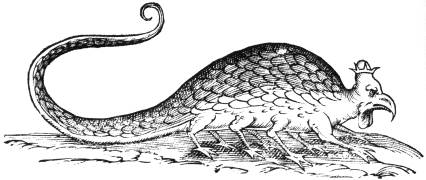
The Cockatrice looked a bit like a chicken and hatched from an egg laid by a cockerel (note: not a hen) which is then incubated by a snake or toad/frog.

Both Basilisk and Cockatrice have emerged more recently as key characters in digital and non-digital role-playing games, as well as children’s literature such as the Harry Potter series. In these roles, these creatures portray the ultimate [non-demoninational] evil, but without the religious connotations of Satan/Lucifer or whatever archdemon is in fashion with a particular religion.
The Basilisk is called “king” because it is reputed to have on its head a mitre, or crown-shaped crest (i.e. like a “king cobra”). Stories over the ages evolved and morphed and show that it was not completely distinguished from the Cockatrice and that essentially there were two similar mythologies, separated in origin by geography, and often merged into one.
Of the Basilisk, Pliny The Elder wrote:
“There is the same power also in the serpent called the basilisk. It is produced in the province of Cyrene, being not more than twelve fingers in length. It has a white spot on the head, strongly resembling a sort of a diadem. When it hisses, all the other serpents fly from it: and it does not advance its body, like the others, by a succession of folds, but moves along upright and erect upon the middle. It destroys all shrubs, not only by its contact, but those even that it has breathed upon; it burns up all the grass, too, and breaks the stones, so tremendous is its noxious influence. It was formerly a general belief that if a man on horseback killed one of these animals with a spear, the poison would run up the weapon and kill, not only the rider but the horse, as well. To this dreadful monster, the effluvium of the weasel is fatal, a thing that has been tried with success, for kings have often desired to see its body when killed; so true is it that it has pleased Nature that there should be nothing without its antidote. The animal is thrown into the hole of the basilisk, which is easily known from the soil around it being infected. The weasel destroys the basilisk by its odour, but dies itself in this struggle of nature against its own self.”
There appears a striking similarity between the Basilisk and Weasel, and the Cobra and the Mongoose. Rudyard Kipling’s short story of Rikki-Tikki-Tavi from The Jungle book anthology follows a similar theme to the writing of Pliny The Elder referenced above.

The essence of the Basilisk was its toxic nature. It was so toxic everything it came into contact with died. Like many snakes, it was associated with the desert. The desert was seen as the result of the Basilisk killing everything.
The toxicity was so great both its breath was fatal as was its glare. Should the Basilisk look at you (or in some versions make eye contact) you would immediately die. The Basilisk doesn’t kill because it hates or has prejudice, it kills because that is simply its nature.
Only weasels and roosters (cockerels) were immune to this toxicity, the weasel could attack whilst the rooster merely had to crow in order to kill the Basilisk. Travellers often carried a rooster with them as a defence against the Basilisk.
The more chicken like Cockatrice also had a deadly glare and deadly breath, and death was more commonly associated with being turned to stone (“petrified“)
Interestingly, the Cockatrice could also be killed by seeing its own reflection. As such mirrored shields were an important tool for defeating this murderous chicken.
Here’s a great video summary:
Themes for Further Exploration
-
- The crowing of a cockerel often indicates sunrise, a new day, a new dawn, a change.
- Mark 14:30 “Truly I tell you,” Jesus answered, “today – yes, tonight – before the rooster crows twice you yourself will disown me three times.“
- John 13:38 “Then Jesus answered, “Will you really lay down your life for me? Very truly I tell you, before the rooster crows, you will disown me three times!“”
- John 18:27 “Again Peter denied it, and at that moment a rooster began to crow.”
- Mark 13:35 “Therefore keep watch because you do not know when the owner of the house will come back – whether in the evening, or at midnight, or when the rooster crows, or at dawn.”
- Job 38:36 “Who gives the ibis wisdom about the flooding of the Nile, or gives the rooster understanding of when to crow?”
The rooster is a sacred animal through history, particularly in Asian, Buddhist and Shamanic cultures.
-
- The rooster is an important feature in Eastern astrotheology.
From Wikipedia: “The lore of the True Shepherd of Anu (SIPA.ZI.AN.NA – Orion and his accompanying animal symbol, the Rooster, with both representing the herald of the gods, being their divinely ordained role to communicate messages of the gods. “The Heavenly Shepherd” or “True Shepherd of Anu” – Anu being the chief god of the heavenly realms. On the star map the figure of the Rooster was shown below and behind the figure of the True Shepherd, both representing the herald of the gods, in his bird and human forms respectively. - The Rooster/chicken is important in Jewish mysticism, and ancient murals of roosters can be found all over Israeli ancient sites.
- In Zoroastrianism, the rooster is the most sacred animal.
- The rooster is an important feature in Eastern astrotheology.
In the Western Qabalah, the Basilisk is attributed to Geburah (Strength), the fifth sephirah on the Tree of Life. Geburah is balanced with Chesed (Mercy). The path connecting these two is that of Teth (which means “serpent”) and is attributed to the Tarot card “Strength” (contemporary) or “Lust” (Thelemic). The path of Teth is a highly sexualised path, and is elucidated by Crowley’s Gnostic Mass.
With the above in mind, read and contemplate Proverbs 30:
Proverbs 30
19 The way of an eagle in the air; the way of a serpent upon a rock; the way of a ship in the midst of the sea; and the way of a man with a maid.
20 Such is the way of an adulterous woman; she eateth, and wipeth her mouth, and saith, I have done no wickedness.
21 For three things the earth is disquieted, and for four which it cannot bear:
22 For a servant when he reigneth; and a fool when he is filled with meat;
23 For an odious woman when she is married; and an handmaid that is heir to her mistress.
24 There be four things which are little upon the earth, but they are exceeding wise:
25 The ants are a people not strong, yet they prepare their meat in the summer;
26 The conies are but a feeble folk, yet make they their houses in the rocks;
27 The locusts have no king, yet go they forth all of them by bands;
28 The spider taketh hold with her hands, and is in kings’ palaces.
29 There be three things which go well, yea, four are comely in going:
30 A lion which is strongest among beasts, and turneth not away for any;
31 A strutting rooster, a he-goat, and a king secure against revolt.
32 If thou hast done foolishly in lifting up thyself, or if thou hast thought evil, lay thine hand upon thy mouth.
33 Surely the churning of milk bringeth forth butter, and the wringing of the nose bringeth forth blood: so the forcing of wrath bringeth forth strife.
And, so what is the point of all this?
The evilest, the most lethal, the most destructive of all anthropomorphic entities is easily killed by its own reflection or by a rooster crowing.
Maybe time for a bit of self-reflection as you begin each new day?