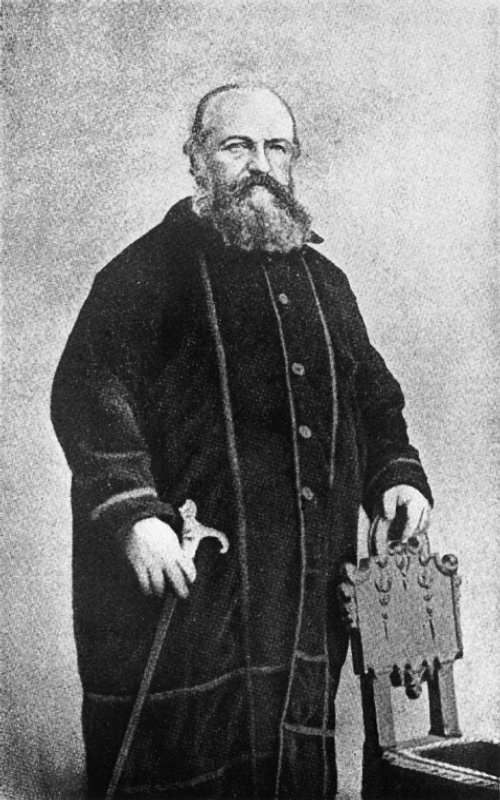
 Eliphas Levi, born Alphonse Louis Constant, was a French occult author and ceremonial magician of the 19th century. He is best known for his influential books on magic and the occult, such as “The Book of Splendours” and “Transcendental Magic.”
Levi’s ideas and writing had a significant impact on the development of modern Western occultism, and he is considered one of the most important figures in the history of ceremonial magic. He is also credited with popularizing the use of the term “occultism” to refer to the study of hidden knowledge and spiritual practices.
Levi’s work drew heavily on the Kabbalah, a form of Jewish mysticism, and he also incorporated elements of Christianity, Hermeticism, and alchemy into his teachings. He believed in the power of the magician to access hidden spiritual truths and to control the forces of nature through the use of ceremonial rituals and invocations.
One of Levi’s most famous contributions to the field of magic is the concept of the “Baphomet,” a symbol that he created and which has since become an important symbol in occultism. The Baphomet is an androgynous figure that represents the balance of male and female energies, and it has been associated with both good and evil.
Levi’s work also had an influence on the Hermetic Order of the Golden Dawn, a secret society that was active in the late 19th and early 20th centuries. Many of the founders of the Golden Dawn, including Aleister Crowley, were heavily influenced by Levi’s ideas and incorporated them into their own teachings.
Despite his importance in the history of magic and the occult, Levi’s ideas have been controversial and have been criticized by both religious and secular authorities. Nevertheless, his work continues to be studied and debated by scholars and practitioners of the occult today.
Baphomet
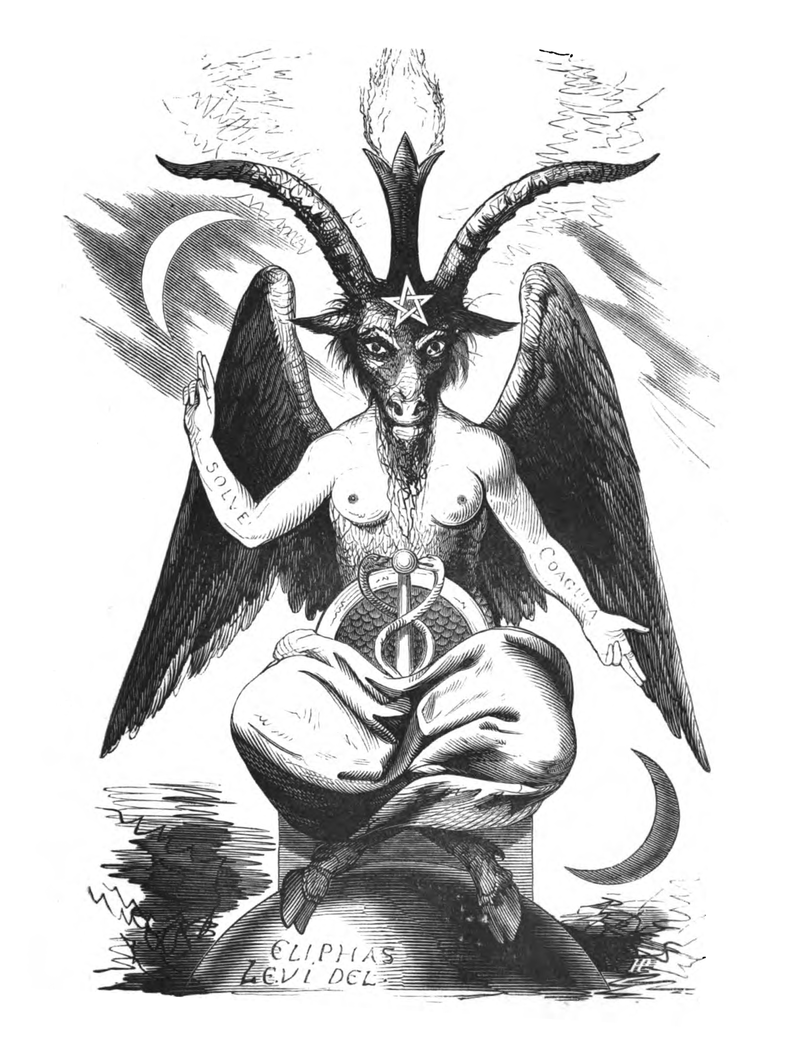 Baphomet is a symbol that was created by Eliphas Levi in the 19th century and has since become an important symbol in the field of occultism. The symbol is typically depicted as an androgynous figure with the head of a goat and the body of a human, and it often includes various other symbols such as a pentagram, a caduceus, and the letters “SOLVE” and “COAGULA” written on the figure’s arms.
According to Levi, the Baphomet represents the balance of male and female energies, and it is a symbol of the “absolute” or the “divine androgyne.” He believed that the figure represents the union of opposites, such as good and evil, light and dark, and spirit and matter.
Baphomet also has been associated with the concept of the “Hermetic Androgyne” which is the union of the microcosm and macrocosm, the human and the divine, the mortal and the immortal. Baphomet also has been associated with the “Sabbatic Goat” which is a representation of the union of the godhead and the animality of man.
The pentagram on the forehead of the Baphomet, according to Levi, represents the five elements of nature: earth, air, fire, water, and spirit. The caduceus, a symbol of the god Hermes, represents the balance between the physical and spiritual realms. The letters “SOLVE” and “COAGULA” written on the figure’s arms, according to Levi, represent the alchemical process of separating and then recombining the elements of nature in order to create something new.
Levi’s interpretation of the Baphomet has been controversial and has been criticized by both religious and secular authorities. Nevertheless, the symbol remains an important part of modern occultism and continues to be used and studied by practitioners of the occult.
“The goat on the frontispiece carries the sign of the pentagram on the forehead, with one point at the top, a symbol of light, his two hands forming the sign of occultism, the one pointing up to the white moon of Chesed, the other pointing down to the black one of Geburah. This sign expresses the perfect harmony of mercy with justice. His one arm is female, the other male like the ones of the androgyne of Khunrath, the attributes of which we had to unite with those of our goat because he is one and the same symbol. The flame of intelligence shining between his horns is the magic light of the universal balance, the image of the soul elevated above matter, as the flame, whilst being tied to matter, shines above it. The beast’s head expresses the horror of the sinner, whose materially acting, solely responsible part has to bear the punishment exclusively; the soul is insensitive according to its nature and can only suffer when it materializes. The rod standing instead of genitals symbolizes eternal life, the body covered with scales: the water, the semi-circle above it: the atmosphere, the feathers following above: the volatile. Humanity is represented by the two breasts and the androgyne arms of this sphinx of the occult sciences.”
— Éliphas Lévi, “Dogme et rituel de la haute magie“
Tarot
Eliphas Levi’s work on the tarot was an important contribution to the field of occultism. He believed that the tarot was a powerful tool for spiritual development and self-discovery, and he devoted a significant portion of his writings to interpreting the meanings of the tarot cards and explaining how they could be used in ceremonial magic and divination.
“The Tarot is a book in pictures, the key to all sacred books, the synthesis of all religions, the hieroglyph of the human mind. It is the mirror in which the soul can see itself, and the key of its own destiny.”
“An imprisoned person with no other book than the Tarot, if he knew how to use it, could in a few years acquire universal knowledge, and would be able to speak on all subjects with unequalled learning and inexhaustible eloquence.”
Levi believed that the tarot was a symbolic representation of the Kabbalah, a form of Jewish mysticism and that the cards could be used as a key to understanding the hidden wisdom of the Kabbalah. He also believed that the tarot was a way to access the unconscious mind and tap into the collective wisdom of humanity.
One of Levi’s most significant contributions to the study of the tarot was his book “The Book of Splendours” (also known as “Transcendental Magic”), in which he provided detailed interpretations of the meanings of the tarot cards. He also provided instructions on how to use the tarot for divination, meditation, and ceremonial magic.
Levi’s work on the tarot had a significant impact on the development of modern tarot interpretation and is considered to be one of the most influential books on the subject. The theme was developed by the Hermetic Order of the Golden Dawn, and then found some later adjustments by Aleister Crowley. Many of his ideas and interpretations continue to be used by tarot readers and practitioners of the occult today.
Catholicism
Levi was raised in a Catholic family and was educated by the Catholic Church. Despite being an occultist, he considered himself to be a devout Catholic throughout his life, and his work on magic and the occult was heavily influenced by his Catholic faith.
Levi believed that the Catholic Church held the key to understanding the hidden wisdom of the universe, and he believed that the sacraments, symbols, and rituals of the Church were powerful tools for spiritual development. He also believed that the Catholic Church held the key to unlocking the secrets of the Kabbalah and other forms of Jewish mysticism, which he believed were the foundation of Western occultism.
Despite his belief in the power of the Catholic Church and its teachings, Levi’s work on magic and the occult was controversial and was often criticized by the Church. He was excommunicated by the Catholic Church and his books were placed on the Index of Forbidden Books.
Transcendental Magic
Eliphas Levi’s “Transcendental Magic” is a book that explores the concepts of magic, mysticism, and the occult. In the book, Levi argues that magic is a science that can be used to understand and control the hidden forces of the universe. He also contends that the true purpose of magic is to transcend the material world and achieve spiritual enlightenment. The book is considered a classic of occult literature and has been influential in the development of various esoteric and occult movements.
Reincarnation as Aleister Crowley?
Aleister Crowley, a British occultist and ceremonial magician of the late 19th and early 20th centuries, did make claims that he was a reincarnation of Eliphas Levi. Crowley had a strong interest in the work of Levi and considered him to be a major influence on his own ideas and teachings. He believed that he was the reincarnation of Levi and that he had been sent to continue the work that Levi had begun.
Crowley claimed that he had a spiritual experience in which he was visited by a vision of Levi, who told him that he was the reincarnation of Levi and had been chosen to continue his work. Crowley also believed that he had been given the task of completing Levi’s unfinished work on the tarot and the Kabbalah.
Crowley’s claims of being a reincarnation of Levi have been controversial and are not widely accepted by scholars of the occult. Many experts believe that Crowley’s claims were largely a product of his own imagination and that he had a tendency to exaggerate his own importance and influence.